

The Importance of Using data-centric Lead Indicators to Predict Operational Efficiency and Effectiveness
- Hosein Gharavi
- Apr 6
- 3 min read
In the dynamic business world, predicting and enhancing operational efficiency and effectiveness is crucial for sustaining competitive advantage. One powerful approach to achieving this is using data-centric operational lead indicators. These proactive measures can provide early warnings about potential issues or opportunities, enabling organisations to take timely corrective actions and make informed strategic decisions when operational red flags occur.
Understanding Operational Lead Indicators
Operational lead indicators are metrics that predict future performance and outcomes. Unlike lagging indicators, which reflect past performance, lead indicators offer a forward-looking perspective. They help organisations anticipate changes, identify risks, and leverage opportunities before they fully materialise.
Examples of Operational Lead Indicators
Employee Training Hours: The time invested in training can predict future productivity, skill development and employee disengagement.
Customer Satisfaction Scores: High satisfaction scores often indicate future loyalty and repeat business, assuming there is no sudden change in the economic or technological predispositions in the market.
Inventory Turnover Rates: Rapid turnover can signal effective inventory management and demand forecasting identifying potential high demand rates for a specific time.
Sales Pipeline Growth: An expanding sales pipeline suggests potential revenue growth in the medium to long term and effective pricing and market penetration strategy.
Equipment Maintenance Schedules: Regular maintenance can prevent future breakdowns and operational disruptions.

How Lead Indicators assist in calibrating organisational effectiveness
Lead Indicators are increasingly used to predict organisational health and sustainable achievement of organisational Objectives and Goals. Early recognition of organisational operational trends allows organisations to make proactive decisions that enhance operational efficiency and effectiveness. For example, tracking training hours can help identify and address skill gaps before they impact performance. Similarly, understanding customer satisfaction trends allows for timely improvements in products or services, fostering customer loyalty and retention.
Operational lead indicators enable organisations to identify and mitigate risks early. For instance, preventive measures can avoid costly downtime if maintenance schedules indicate potential equipment failures. Organisations can maintain smooth operations and minimise disruptions by addressing issues before they escalate.
Lead indicators provide valuable insights that inform strategic planning. They help organisations align their resources and efforts with anticipated market trends and internal capabilities.
The use of lead indicators fosters a culture of continuous improvement. Organisations can set benchmarks and monitor progress against these indicators to drive ongoing enhancements in processes, products, and services. This proactive approach ensures that the organisation remains agile and responsive to changing market conditions.
The Use of Lead Indicators in Higher Education
Using operational lead indicators in higher education exemplifies how performance lead indicators can help identify students' propensity to discontinue studies. Student attrition is a pressing concern for educational institutions worldwide. High attrition rates can impact the institution's reputation, financial stability, and student success. One effective way to address this issue is by leveraging student performance data. This data-driven approach allows educators and administrators to identify at-risk students early and implement targeted interventions to help retain them.
Student performance data encompasses a wide range of information, including grades, attendance records, participation in extracurricular activities, rate of assessment submission and academic misconduct.
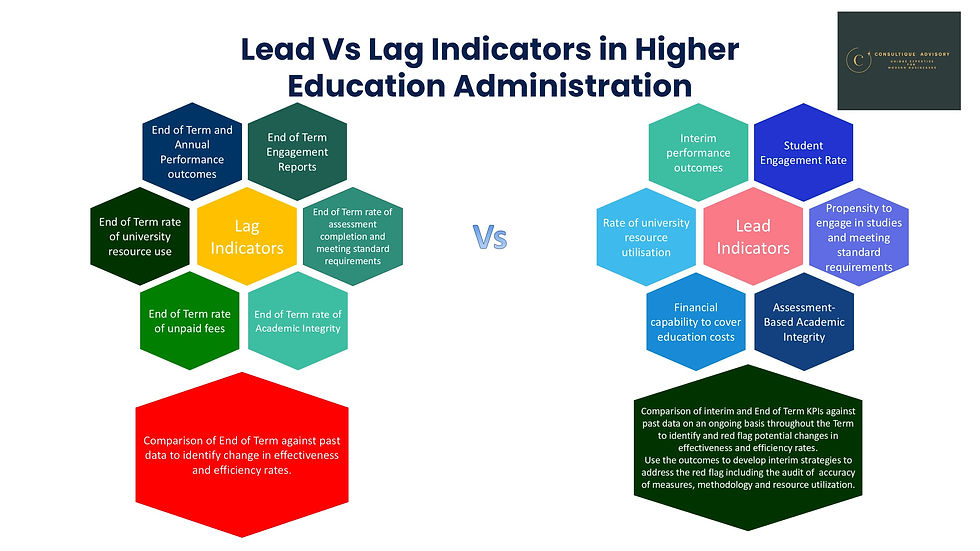
The data-driven performance forecasting and risk mitigation process involves effectively identifying relevant Key Performance Indicators that correlate with higher dropout rates and using predictive analytics to forecast which students are at risk.
This continuous audit, engagement, and intervention process is doable and efficient in a small-scale operation. The question is how this efficiency can be extended to a scenario where enrolments are high and many programs are on offer.
Moving on from relatively medium-size operations (post-COVID), organisations can use statistical techniques and machine learning algorithms to analyse historical data to predict future outcomes across large student cohorts with multiple programs.
Identifying a relevant, valid, and reliable data modelling technique can enable the development of targeted intervention techniques to ensure a high-level student learning protocol.
In conclusion, operational lead indicators are essential for predicting and enhancing operational efficiency and effectiveness. Providing early insights into potential issues and opportunities enables organisations to make proactive decisions, mitigate risks, enhance strategic planning, and drive continuous improvement. In an ever-changing business landscape, organisations that leverage lead indicators are better positioned to achieve sustained success and maintain a competitive edge.



Comments