

Leveraging Predictive Analytics for Fair Salary Adjustments: A Strategic Guide for HR Leaders and Executives
- Hosein Gharavi
- Jul 17, 2025
- 4 min read
In today's competitive talent landscape, equitable compensation is not just a moral imperative—it's a business necessity. Predictive analytics, powered by artificial intelligence, offers organisations a sophisticated approach to salary management that ensures fairness, maintains competitiveness, and drives employee engagement. This guide outlines seven critical ways predictive analytics transform compensation strategy from reactive to proactive, delivering measurable improvements in equity and organisational performance.
The Strategic Imperative
Organisations face increasing pressure to demonstrate pay equity while remaining competitive in volatile talent markets. Traditional compensation approaches—often subjective and retrospective—leave companies vulnerable to pay disparities, regulatory scrutiny, and talent attrition. Predictive analytics provides the data-driven foundation necessary to build compensation systems that are both fair and strategically sound.
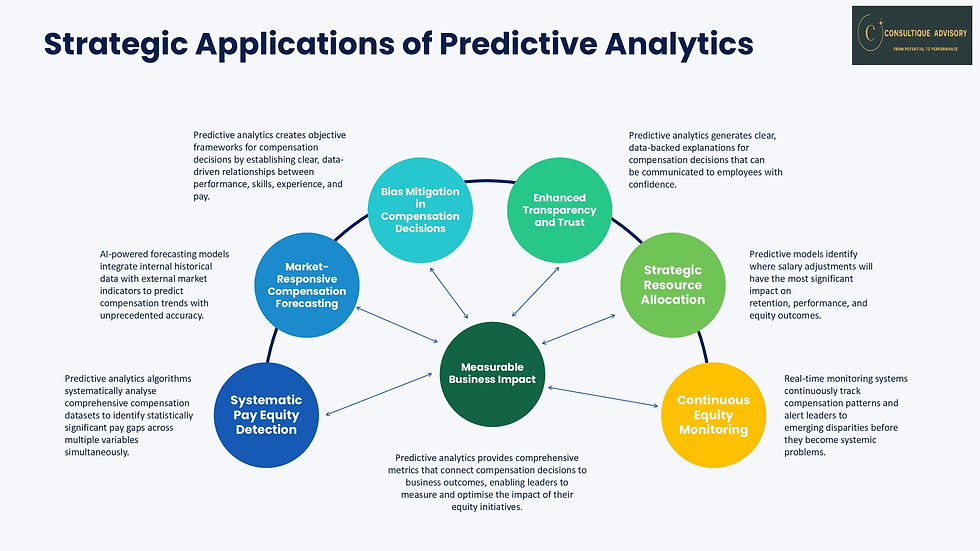
Seven Strategic Applications of Predictive Analytics
1. Systematic Pay Equity Detection
The Challenge: Hidden compensation disparities across demographic groups, job functions, and geographic locations often remain undetected until they become legal or reputational liabilities.
The Solution: Predictive analytics algorithms systematically analyse comprehensive compensation datasets to identify statistically significant pay gaps across multiple variables simultaneously. This capability extends far beyond basic demographic comparisons to uncover complex intersectional disparities that manual analysis would miss.
Strategic Value:
Proactive identification of equity issues before they escalate
Comprehensive analysis across multiple dimensions (gender, race, experience, performance, location)
Automated monitoring that scales with organisational growth
2. Market-Responsive Compensation Forecasting
The Challenge: Static salary structures quickly become obsolete in dynamic markets, resulting in competitive disadvantage and increased risk of turnover.
The Solution: AI-powered forecasting models integrate internal historical data with external market indicators to predict compensation trends with unprecedented accuracy. These models account for industry evolution, geographic cost variations, and fluctuations in demand for skills.
Strategic Value:
Anticipatory adjustments that maintain competitive positioning
Data-driven budget planning with improved accuracy
Reduced reactionary salary corrections and associated costs
3. Bias Mitigation in Compensation Decisions
The Challenge: Unconscious bias in salary decisions perpetuates inequities and exposes organisations to legal and reputational risks.
The Solution: Predictive analytics creates objective frameworks for compensation decisions by establishing clear, data-driven relationships between performance, skills, experience, and pay. This systematic approach removes subjective interpretation from salary determinations.
Strategic Value:
Measurable reduction in compensation bias
Defensible salary decisions based on objective criteria
Improved confidence in compensation fairness across the organisation
4. Enhanced Transparency and Trust
The Challenge: Employees are increasingly demanding transparency in compensation practices, yet many organisations struggle to provide clear rationales for their pay decisions.
The Solution: Predictive analytics generates clear, data-backed explanations for compensation decisions that can be communicated to employees with confidence. This transparency fosters trust and demonstrates the organisation's commitment to fairness.
Strategic Value:
Improved employee satisfaction and engagement
Reduced compensation-related grievances and disputes
Enhanced employer brand and talent attraction capabilities
5. Strategic Resource Allocation
The Challenge: Limited compensation budgets must be allocated efficiently to maximise both equity and competitive positioning.
The Solution: Predictive models identify where salary adjustments will have the most significant impact on retention, performance, and equity outcomes. This enables strategic prioritisation of compensation investments.
Strategic Value:
Optimised return on compensation investment
Data-driven justification for budget allocation decisions
Improved retention of critical talent through targeted adjustments
6. Continuous Equity Monitoring
The Challenge: Compensation equity is not a one-time achievement, but rather a continuous effort that requires ongoing vigilance as organisations evolve.
The Solution: Real-time monitoring systems continuously track compensation patterns and alert leaders to emerging disparities before they become systemic problems. This creates a self-correcting compensation ecosystem.
Strategic Value:
Prevention of equity regression over time
Compliance with evolving regulatory requirements
Sustained competitive advantage through consistent fairness
7. Measurable Business Impact
The Challenge: Compensation investments must demonstrate clear returns on investment to maintain organisational support.
The Solution: Predictive analytics provides comprehensive metrics that connect compensation decisions to business outcomes, enabling leaders to measure and optimise the impact of their equity initiatives.
Implementation Framework
Phase 1: Foundation Building
Comprehensive data audit and quality assessment
Stakeholder alignment on equity objectives
Technology platform selection and integration
Phase 2: Model Development
Predictive model creation and validation
Initial equity analysis and gap identification
Change management preparation
Phase 3: Implementation
Pilot program execution with select groups
System refinement based on initial results
Manager training and communication strategy deployment
Phase 4: Scale and Optimise
Organisation-wide deployment
Continuous monitoring system activation
Regular model refinement and improvement
Conclusion: The Competitive Advantage of Equity
Predictive analytics transforms compensation from a cost centre to a strategic asset. Organisations that leverage these capabilities gain measurable advantages in talent attraction, retention, and performance, while building resilient and equitable workplace cultures.
The question for leaders is not whether to invest in predictive compensation analytics, but how quickly they can implement these capabilities to gain a competitive advantage while fulfilling their ethical obligations to employees.
The path forward is clear: Organisations that proactively embrace data-driven compensation equity will lead their industries in talent outcomes, while those that maintain status quo approaches will face increasing disadvantages in an equity-conscious marketplace.



Comments