

How AI Personalises Support to Prevent Student Dropout
- Hosein Gharavi
- Aug 4, 2025
- 4 min read
Artificial intelligence is transforming how educational institutions identify and support at-risk students by delivering data-driven, personalised interventions that address each student's unique challenges before they lead to dropout. This proactive approach represents a significant advancement over traditional reactive support systems.
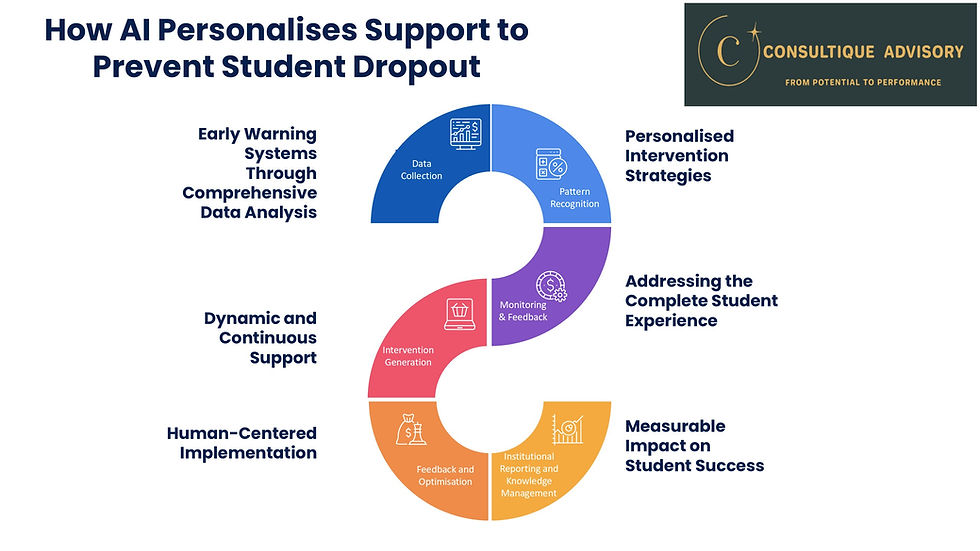
Early Warning Systems Through Comprehensive Data Analysis
AI systems continuously monitor multiple data streams to create a comprehensive picture of student engagement and academic health. These systems analyse academic performance metrics, attendance patterns, assignment submission behaviours, participation in learning management systems, and even sentiment analysis of student communications to detect early warning signs of disengagement.
Machine learning algorithms compare individual student patterns against successful completion benchmarks, enabling institutions to identify students at risk weeks or months before traditional indicators would surface. This predictive capability allows for timely intervention rather than crisis response.
Personalised Intervention Strategies
When AI identifies a student at risk, it triggers personalised support mechanisms tailored to the specific challenges identified. The system can automatically alert academic advisors with detailed risk assessments, send customised messages to students with relevant resources, or adjust learning pathways to match individual needs better.
Addressing the Complete Student Experience
Modern AI systems recognise that factors beyond coursework influence academic performance. These platforms can identify patterns suggesting financial stress, mental health challenges, or social isolation that contribute to dropout risk. By integrating this holistic view, institutions can coordinate comprehensive support services.
AI-driven accessibility tools also ensure that students with diverse learning needs receive appropriate accommodations and resources, removing barriers that might otherwise impede their success.
Dynamic and Continuous Support
Unlike static intervention programs, AI-powered systems continuously adapt their recommendations based on student response and progress. This creates dynamic feedback loops where support strategies evolve with changing student needs, ensuring interventions remain relevant and practical throughout the academic journey.
The system learns from each interaction, refining its ability to predict risk factors and recommend interventions that have proven most effective for students with similar profiles and challenges.
Human-Centered Implementation
Successful AI implementation in student support requires thoughtful human-AI collaboration. While AI excels at data analysis and pattern recognition, human educators provide the relationship-building, mentorship, and nuanced understanding that students need for long-term success.
Educational institutions implementing these systems must also prioritise ethical considerations, including data privacy, algorithmic transparency, and bias mitigation, to ensure equitable support for all students.
Measurable Impact on Student Success
By personalising support through AI, institutions achieve more than just improved retention rates. Students experience enhanced learning outcomes, increased satisfaction with their educational experience, and better preparation for long-term academic and professional success. This personalised approach transforms the traditional one-size-fits-all support model into a responsive, student-centred system that adapts to individual needs and circumstances.
The result is a more effective, efficient, and equitable approach to student support that helps ensure every student has the opportunity to reach their full potential.
The mechanics of a Lead Indicator System
AI analyses individual engagement patterns to tailor interventions through a series of advanced techniques that process, interpret, and act on rich behavioural data. Here’s how this process works in an educational or engagement context:
1. Data Collection and Feature Extraction
Behavioural Metrics: AI collects data from multiple sources, such as online activity logs, coursework completion rates, communication history, participation in group work, and responses to engagement surveys.
Sentiment and Mood Analysis: Natural Language Processing (NLP) and emotion recognition algorithms analyse text (discussion posts, emails, chat logs) and sometimes voice or video, to gauge emotional states related to motivation, frustration, or disengagement.
2. Pattern Recognition and Predictive Modelling
Machine Learning Models: AI applies unsupervised and supervised learning techniques to detect patterns within the engagement data that may not be obvious to humans. For instance, changes in login frequency, accelerated or declined assignment submissions, or shifts in communication style can signal engagement dips.
Correlation Analysis: By studying how different metrics relate—such as a drop in discussion participation paired with missed assignments—AI can infer likely causes and predict potential disengagement or dropout risk.
3. Real-Time Monitoring and Feedback
Continuous Tracking: Unlike periodic human reviews, AI enables real-time analysis, allowing for instant detection of abnormalities or trends in individual engagement.
Sentiment Analysis: AI algorithms immediately flag negative sentiment (boredom, confusion, frustration) detected in communications, enabling rapid, personalised support.
4. Tailored Intervention Generation
Personalised Recommendations: Based on the identified patterns, AI recommends specific actions, such as suggesting additional resources, modifying learning pathways, or prompting check-ins with advisors or counsellors.
Adaptive Engagement: If a student shows signs of disengagement, AI can prompt changes in instructional methods, send motivational messages, or initiate proactive outreach tailored to that student’s engagement profile.
5. Continuous Feedback and Optimisation
Iterative Learning: AI continues to refine its models using new engagement data and the results of past interventions. This continuous loop ensures interventions become more accurate and personalised over time.
Outcome Tracking: AI tracks which interventions succeed for each individual and adjusts future recommendations accordingly, prioritising strategies with demonstrated effectiveness.
By harnessing these methods, AI can offer proactive, custom-tailored interventions aligned with each individual’s unique engagement patterns, maximising retention, motivation, and overall success.
Between 2019 and 2024, “University Name Withheld” implemented a lead Indicator- student performance pattern analysis to identify red flags that would then highlight students who had a higher-than-average propensity to attrition and abandonment of their studies well into their enrollment as full-time international students. The protocol resulted in an average reduction of 20% in total attrition and a decrease of 15% in first-year student abandonment. This proactive identification, contact and intervention protocol significantly improved overall academic performance across the case organisation.



Comments